
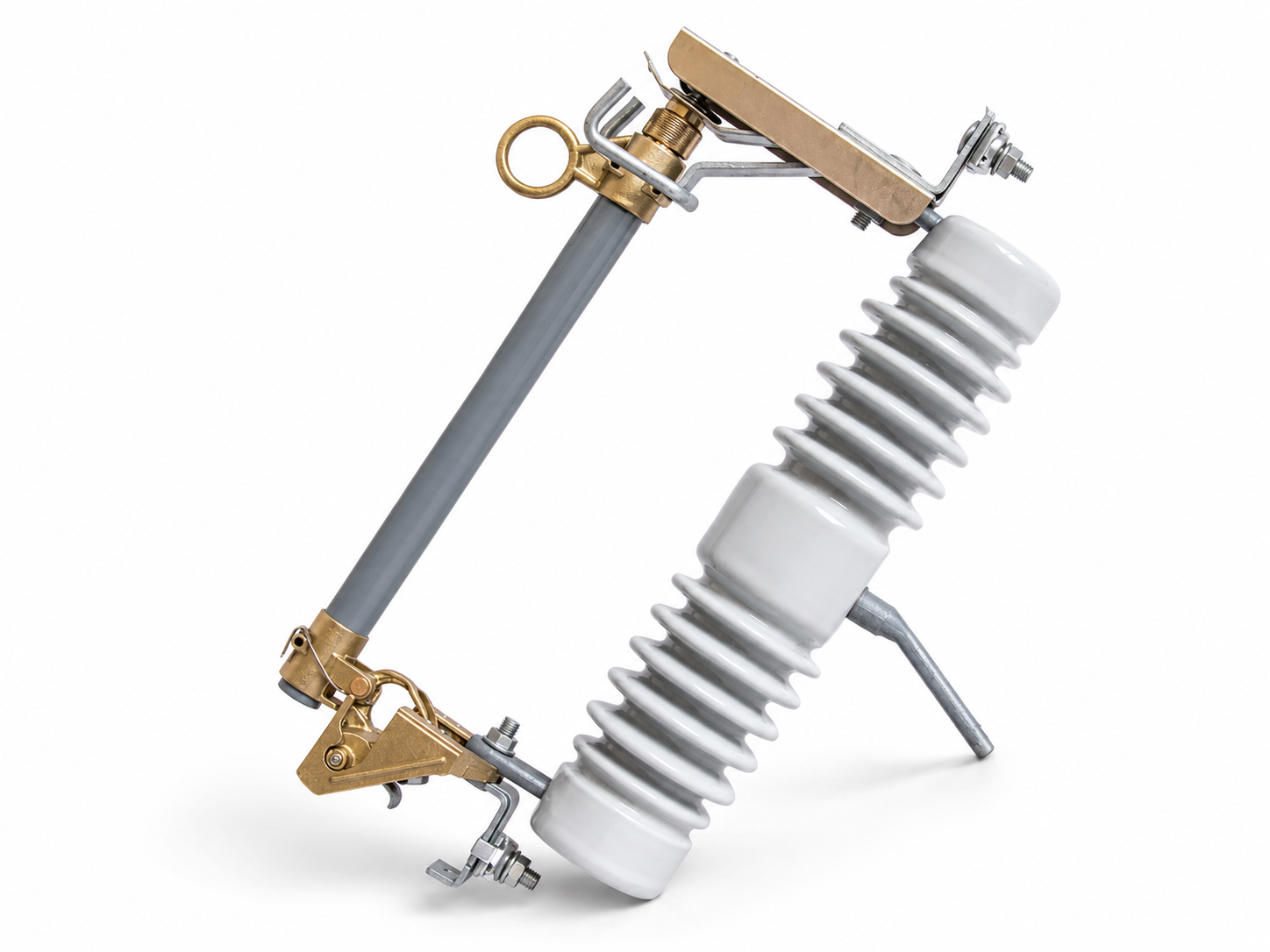
Polymer Drop-Out Fuse Cutouts
HRW11 – 12kV – 100/200A – 3.9 kg – IEC 60282-2
Lightweight silicone-rubber polymer-housed expulsion cutout for 12kV overhead lines. Hydrophobic HTV insulator resists pollution flashover, passes 1,000-hour salt spray, and weighs half of porcelain. Export-optimized design.
OEM / ODM – Low-MOQ samples – Type-test reports
Overview
The HRW11-12 polymer fuse cutout replaces the traditional porcelain housing with a one-piece injection-molded HTV silicone rubber insulator bonded directly to a fiberglass-epoxy core rod. This composite construction eliminates the cement-bonding step and its associated failure modes, while delivering several practical advantages for modern distribution networks.
Hydrophobicity is the key material advantage. Silicone rubber naturally repels water — moisture beads on the surface rather than forming a continuous conductive film. This suppresses leakage current and dramatically reduces flashover risk in coastal, humid, and heavily polluted environments. The material also passes the 1,000-hour salt fog test (ASTM B117) with minimal tracking or erosion.
Weighing just 3.9-4.1 kg (vs. 5.6-7.5 kg for equivalent porcelain models), polymer cutouts reduce pole loading and cut shipping costs — a meaningful advantage for export volumes. The non-brittle construction resists impact damage during transport and installation, and survives seismic events that would crack ceramic housings.
Best for: coastal and polluted environments / export projects where shipping weight matters / areas with high vandalism or seismic risk / projects where hot-stick handling weight is a safety concern. For traditional inland installations, see Porcelain RW11 series.
Technical Specifications
| Rated Voltage | 10-12 kV |
|---|---|
| Rated Current | 100 A / 200 A |
| Breaking Capacity | 6.3 kA (100A) / 8-12.5 kA (200A) |
| BIL to ground | 75-110 kV |
| Power Freq Dry Withstand | 42 kV rms |
| Power Freq Wet Withstand | 30 kV rms |
| Creepage Distance | 260-350 mm |
| Insulator Body | HTV silicone rubber, 1-piece injection molded |
| Core Rod | Fiberglass-epoxy, crimped to end fittings |
| Fuse Tube | Epoxy fiberglass filament-wound, arc-quenching liner |
| Contacts | Copper alloy, silver-plated >=2 um |
| Hardware | Hot-dip galvanized steel >=86 um zinc |
| Weight | ~3.9 kg (100A) / ~4.1 kg (200A) |
| Dimensions | ~480 x 280 x 115 mm |
| Temperature | -40 to +80 C (silicone rated) |
| Standards | IEC 60282-2 / ANSI C37.42 |
Range
| Model | Export Name | Current | Breaking | Weight |
|---|---|---|---|---|
| HRW11-10/100 | 12kV/100A Polymer | 100 A | 6.3 kA | 3.9 kg |
| HRW11-10/200 | 12kV/200A Polymer | 200 A | 8-12.5 kA | 4.1 kg |
| HRW11-24/100 | 24kV/100A Polymer | 100 A | 6.3 kA | ~7 kg |
| HRW11-24/200 | 24kV/200A Polymer | 200 A | 8-12 kA | ~8 kg |
Also available as HRW10-10F with bimetal overload protection. NEMA B bracket standard.
Key Features
Water beads on surface, suppressing leakage current and flashover in rain, fog, and coastal salt spray. Passes 1,000h salt fog without tracking.
3.9 kg vs 7.5 kg reduces pole loading, shipping cost, and installer fatigue. Non-brittle resists transport damage.
HTV silicone rated -40C to +80C with carbon-black UV protection. No chalking, cracking, or embrittlement over 25+ year expected life.
Unlike brittle ceramic, the polymer-fiberglass composite flexes under mechanical shock without cracking. Survives 8 degree seismic events.
No cement joints to fail. The silicone is bonded directly to the fiberglass rod in a single injection-molding step, eliminating the flange separation failure mode of porcelain units.
Lighter tube means easier single-handed operation with insulated hot-stick. Spring-loaded toggle mechanism ensures reliable dropout even in icy conditions.
Applications
The best choice for installations within 5km of coastline. Salt spray that causes porcelain tracking within 2-3 years leaves silicone unaffected for decades.
Tropical, monsoon, and fog-prone areas where continuous moisture films on porcelain cause flashover. Silicone hydrophobicity eliminates the moisture film.
At ~4kg per unit vs 7.5kg, a container of 500 polymer cutouts saves ~1,750 kg dead weight vs porcelain-equivalent freight costs.
Areas with earthquake risk >=7 degrees benefit from non-brittle polymer that flexes rather than fractures during ground movement.
Frequently Asked Questions
How is polymer different from porcelain?
Will silicone rubber degrade in sunlight?
Are polymer cutouts more expensive?
Can I retrofit polymer cutouts onto existing porcelain brackets?
Need Polymer Cutouts for a Coastal Project?
Tell us the voltage, current and site conditions — we will recommend the right model and ship within 15 days.
Request a Quote
Send your requirement, model or drawing — we reply within 24 hours.
Thank You!
Your inquiry has been received.
We'll reply with a detailed quote within 24 hours.